THE MARGIN · WRITTEN DOWN, NOT IMPLIED
How we make the call
Every operator says safety comes first. This page is what that actually means at 05:30 with the forecast open: the ratios, the comms, the numbers, and the mornings we turn around.
RATIOS · THE TERRAIN SETS THEM, NOT THE MARGIN
1:8
SUMMER TREKKING · ONE QUALIFIED GUIDE, EIGHT WALKERS, HARD CAP
1:6
WINTER · WHEN THE GROUND CAN AVALANCHE, THE GROUP SHRINKS
1:4
GRADE-5 & SKILLS TERRAIN · CLOSE ENOUGH TO GRAB A RUCKSACK STRAP
100%
OF TRIPS CARRY SATELLITE COMMS · NO EXCEPTIONS SINCE 2016
Where we work abroad, local partner guides come on top of these numbers, not instead of them. Ratios never stretch for a full trip, a big group booking or a good forecast — the whole point of a ratio is that it holds on the bad day.
COMMS · WHERE THE SIGNAL DIES, WE BRING OUR OWN
Checked in, twice a day
01 · CARRIED
inReach on every trip
Every guide carries a Garmin inReach satellite communicator — two-way text and SOS anywhere on the planet, independent of phone networks. On expeditions above 4,000m or beyond a day from a road, a second unit rides in the group kit as backup.
02 · SCHEDULED
07:30 and 18:30, UK time
Two check-ins a day to Keswick: position, plan, souls on board. Family can follow the track live if you want them to. The schedule is boring by design — boring is what a well-run trip sounds like from the outside.
03 · MISSED
The cascade
A missed check-in starts a clock, not a panic. Ninety minutes: retry on both units. Three hours: our in-country partner moves. Six hours: rescue services get our route card, last position and group medicals — all pre-filed before departure. We test the cascade twice a year, unannounced.
THE WEATHER RULE
We turn back. That's the deal.
Every itinerary has escape routes drawn before we sell a single place, and a spare day nobody is embarrassed to use. Every guide has the authority — and the pay structure — to turn a summit day into a valley day without a phone call to head office. Summits are optional. Coming home isn't.
The rule has a price and we pay it in public. In twelve years we have turned back on roughly one trip day in fourteen, rerouted dozens more, and cancelled outright when the mountain left no version of the plan worth selling.
A WORKED EXAMPLE · 07 FEB 2026
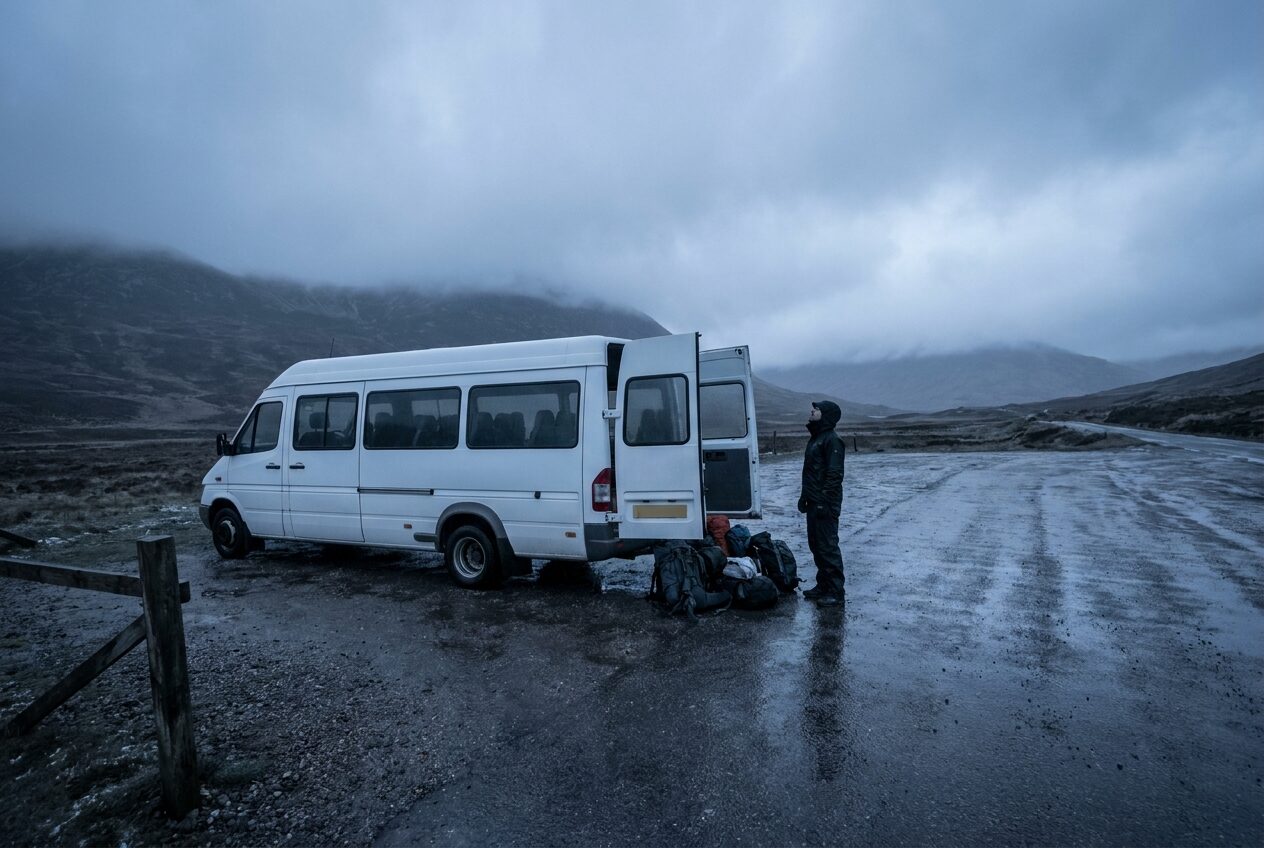
This February we cancelled a Cairngorms winter skills course on the second morning — 85mph gusts, SAIS at Considerable on every aspect our syllabus needed, and a thaw-freeze crust that made the teaching pointless even where it was safe. We taught crampon work on a low bank, walked out through Ryvoan, and gave everyone the choice of a full transfer or a full refund. Six of eight rebooked before the minibus reached Aviemore. The whole morning is written up in the journal, including the whiteboard numbers.
ONE MORNING, MINUTE BY MINUTE
Anatomy of the call
The 07 February decision, reconstructed from the guide log. This is what every trip morning looks like — most just end with "go".
Forecast pull
Kettle on, three sources open, no shortcuts: MWIS for the story, Met Office mountain forecast for the timing, last night's SAIS report for the snowpack. The numbers go on the whiteboard exactly as published — the group will see them at breakfast, not a summary of them.
WIND W 70 GUSTING 85 · FREEZING LEVEL 900M FALLING · SNOW SHOWERS ABOVE 700M · VIS 20–50M ON THE PLATEAU
Avalanche report
The morning SAIS Cairngorms report lands. Considerable (3) on north through east aspects above 900m — which is precisely where the syllabus wants to be. Wind-slab building on lee slopes through the day. A hazard rating is not a dare; it is a boundary drawn by people who dug the pits.
SAIS · CONSIDERABLE (3) · N–E ASPECTS >900M · WIND SLAB ON LEE SLOPES · CORNICE COLLAPSE POSSIBLE
The options table
Two guides and the office on one short call. Nobody argues the forecast; we argue the options: plateau plan as sold, low-corrie teaching below the hazard line, or the valley circuit through Ryvoan with navigation legs and axe work on safe banks. Each option gets the same three gates.
Three gates, none open
GATE 1 · WIND ≤55MPH ON THE TOPS — FAILED (70 G 85)
GATE 2 · VISIBILITY ≥200M — FAILED (20–50M)
GATE 3 · SAIS ≤2 ON OUR ASPECTS — FAILED (3)
Any gate failing sends us down a level. All three failing ends the discussion — there is no version of the plateau day worth selling, and a skills course that cannot teach its syllabus is a walk in bad weather at £130 a head. The fork below is the whole decision, drawn honestly.
We walked the valley route instead
Breakfast briefing: the whiteboard does the talking, nobody argues with numbers. Then a day that was still worth having — crampon work on a frozen bank, navigation legs in shelter, an hour on snowpack in the pines with the wind roaring somewhere above the trees. Not the course anyone booked. The course was cancelled that evening, money moved back the same week, and the plateau was still there in March. It usually is.
ALTITUDE · PATIENCE, MEASURED
The altitude protocol
Acclimatisation is physiology, not fitness, and it runs on its own clock. Our itineraries are built around the numbers below and we do not trim them to make a trip a day shorter — the reasoning is written up in the journal.
- Above 3,000m, sleeping altitude rises by no more than 500m a day — the walking can go higher, the tent doesn't.
- A full rest day for every 1,000m of new sleeping altitude, scheduled, not "if needed".
- Climb high, sleep low wherever the terrain allows it.
- Descent is the treatment. Everything else is management.
WHAT THE GUIDE MONITORS, EVERY MORNING
- Oxygen saturation by pulse oximeter, logged per walker against their own baseline — trend matters more than the number.
- Resting heart rate, appetite, sleep quality and headache — scored against the Lake Louise system when anything looks off.
- Diamox: we neither prescribe nor discourage it — talk to your GP before you fly, and tell the guide what you decided.
- Anyone descending, descends accompanied. Nobody is ever sent down alone, and nobody is ever left to "see how it goes" overnight above the last safe camp.
WINTER · SCOTLAND & THE ALPS
How we read avalanche terrain
01 · FORECAST FIRST
SAIS and EAWS
Scottish days start with the SAIS report for the massif; Alpine winters use the EAWS bulletin scale. Route plans are drawn on the evening report and re-checked against the morning one — aspects and altitudes the forecast flags are simply off the menu, whatever the sky looks like.
02 · GROUND TRUTH
Pits, probes, turns
Forecasts are regional; slopes are personal. Guides test as they go — quick pits, hand shears, watching for whumpfs and shooting cracks — and the plan bends to what the snow says. On skills courses you dig too: judgement is the syllabus, not a bonus.
03 · CARRIED & TRAINED
Transceiver, shovel, probe
On every winter trip each walker carries all three — ours, provided and checked — and the first hour of day one is a live transceiver search, repeated until it works under stress. Kit you can't use at speed is ballast.
INSURANCE, PLAINLY
Cover we actually check
You need travel insurance that covers trekking to the maximum altitude of your trip — with helicopter evacuation where the route warrants it. We check every policy before departure, because "activity cover" small print has ruined better holidays than ours. For UK trips, BMC membership is worth having anyway: it funds the access and mountain rescue infrastructure every one of our routes leans on. Our guides are individually insured and hold outdoor-specific first aid, minimum 16 hours, revalidated every three years.
KIT · THE NON-NEGOTIABLES
Five things we will check at the trailhead
- Boots broken in — and B2-rated where the trip notes say so
- Full waterproofs, jacket and trousers, that you trust
- Headtorch with spare batteries
- An insulated layer rated for the trip's coldest forecast
- The winter metalwork where listed — hired from us is fine, absent is not
The full list builds itself per trip in the kit room, weights included. If something on it surprises you, ask before you buy.
ASKED EVERY SEASON
Fair questions, straight answers
The guide, alone. We will explain the reasoning out loud — the group deserves to hear the arithmetic — but the decision is not a vote. Our guides are paid the same whether the trip summits or not, so there is no incentive to push a bad day. Nobody at Wildtrace has ever been criticised for turning around.
First we reroute — every itinerary has escape routes and a spare day built in. If the mountain plan becomes a valley plan, we say so plainly and refund any cost difference. If the whole trip is unrunnable, as with our February 2026 Cairngorms course, you choose between a full transfer to another date or a full refund. Weather is not a booking-conditions trapdoor.
Yes — travel insurance that specifically covers trekking to the maximum altitude of your trip, including helicopter evacuation where relevant. We check every policy before departure. For UK trips we recommend BMC membership; it supports the access and rescue infrastructure every route depends on.
Your guide logs oxygen saturation and symptoms every morning on altitude trips, scored against the Lake Louise system when anything looks off. Mild symptoms mean rest — the itinerary already has the slack. Worsening symptoms mean descent, that day, accompanied. Descent is never negotiable. In twelve years: zero altitude evacuations, because we go up slowly enough not to need them.
THE OTHER SIDE OF THE MARGIN
Caution is why it's fun.
The turning back is what buys the wild days. Come and spend some.